By admin September 28, 2026
Cannabis delivery payment rules by state differ on who may deliver, what may leave the dispensary, who can receive the order, and when payment may occur. Cash and approved bank-account payments can be relevant, but state delivery authorization does not automatically authorize card acceptance. Operators must satisfy state rules and their bank, acquirer, network, and payment-provider requirements.
Launching cannabis delivery is not simply a matter of adding a driver to an online ordering system. The delivery order, payment status, POS transaction, vehicle inventory, manifest or delivery ledger, ID check, state track-and-trace record, returned inventory, and final bank settlement all need to tell the same story.
The state comparison below was verified September 27, 2026 against current primary regulations and regulator materials. Proposed regulations are identified as proposed rather than treated as effective law.
Cannabis Delivery Payment Rules by State: Quick Comparison
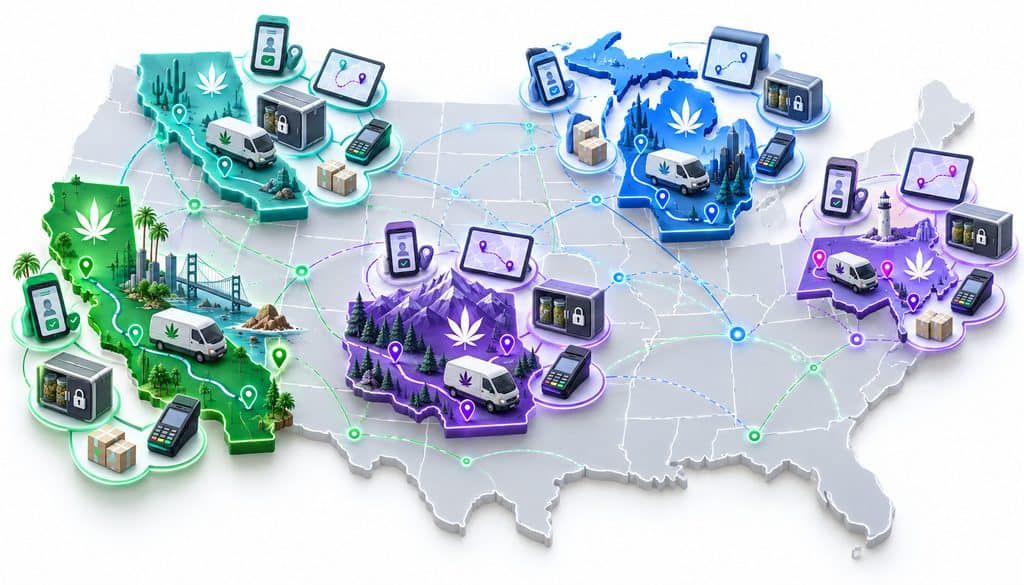
The table below summarizes the most important cannabis delivery payment rules by state for California, Michigan, Nevada, Massachusetts, and Colorado, including door-payment treatment, vehicle inventory controls, driver requirements, and state tracking obligations.
| State | Licensed Delivery Framework | Who May Deliver? | Payment Timing / Door Payment | Cash / Inventory Restriction | Key Driver / Manifest Rule |
| California | Licensed retailers may deliver; Type 9 retailers are delivery-only and Type 10 storefront retailers may also deliver | Delivery employee directly employed by the licensed retailer and at least 21 | Current DCC delivery regulations do not mandate one tender type or universal prepayment | No numeric statewide driver-cash cap identified. Cannabis goods in the vehicle cannot exceed $10,000 current retail value | CCTT delivery inventory ledger must be created before departure; dynamic inventory is permitted within the rule; dedicated GPS and stop log required |
| Michigan | Marijuana sales locations may deliver after CRA approval of their delivery procedures | Employee of the marijuana sales location | Online payment is allowed, and the employee may take payment upon delivery | No numeric driver-cash cap identified. Vehicle product value capped at $5,000, with no more than $3,000 unordered at departure; adult-use delivery also has a 15-ounce / 60-gram concentrate transport ceiling | GPS, pre-departure inventory ledger, stop log, delivery requests, and 30-minute return rule |
| Nevada | Cannabis sales facilities may deliver under NAC 678B.321–.330 | Properly registered sales-facility agent employed by the facility or qualifying disclosed contractor | Delivery rules do not prescribe one universal tender type; agent cannot buy cannabis personally and seek reimbursement | No numeric statewide cash cap identified. Ordinary delivery trip limited to 5 ounces or equivalent; separate medical-only limit applies | Seed-to-sale manifest identifies specific inventory for each consumer; ID scan; secured vehicle inventory |
| Massachusetts | Delivery Operators, Marijuana Couriers, and establishments with applicable delivery authority operate under 935 CMR 500.145 | Registered agents under the applicable licensed delivery structure | Regulations expressly contemplate cash and encourage electronic payment; they do not authorize every electronic payment product | No numeric cash cap. Vehicle marijuana value capped at $5,000 with one agent / $10,000 with two | Every product must correspond to a specific individual order; seed-to-sale tracking and locked cash storage required |
| Colorado | Stores and qualifying transporters with delivery permits may deliver subject to state and applicable local authorization | Properly licensed personnel associated with the permitted store/transporter | Rule 3-615 expressly permits legal payment methods, qualifying prepayment, and payment on delivery | No numeric driver-cash cap identified. Product value capped at $10,000 enclosed / $2,000 unenclosed vehicle | Order must exist before product enters vehicle; real-time tracking, locked opaque storage, video and transport manifest required |
California’s current regulation expressly caps the retail value of cannabis in a delivery vehicle at $10,000 and requires a pre-departure delivery inventory ledger in the track-and-trace system.
Unlike an order-only model, the ledger separately identifies products already ordered before departure, while the rule permits delivery requests to be received while a trip is underway so long as the required delivery request exists before arrival.
Michigan follows a different hybrid model. R 420.207 caps vehicle inventory at $5,000 current retail value, restricts unordered inventory to $3,000, requires at least one processed order before departure, and separately limits an adult-use retailer making deliveries to 15 ounces of marijuana or 60 grams of concentrate at one time.
Massachusetts and Colorado are more clearly order-specific. Massachusetts requires every marijuana product in the consumer-delivery vehicle to be associated with a specific individual order. Colorado requires the order to exist and the product to be prepared and labeled before it enters the delivery vehicle.
Can Cannabis Customers Pay at the Door?
One of the biggest differences in cannabis delivery payment rules by state is whether the regulation expressly addresses payment upon delivery, merely anticipates cash or electronic payments, or remains silent on tender timing.
The answer depends on the state.
Michigan’s current R 420.207 expressly says the delivery employee may take payment upon delivery. The same rule also permits the sales location to accept an online order and payment for delivery.
Colorado Rule 3-615 likewise expressly permits a store to accept a legal payment method, gift-card prepayment, qualifying store prepayment accounts, or payment on delivery. A marijuana transporter may also accept payment on behalf of the store at the point of transfer.
Massachusetts does not need to say “cash at the door” in those exact words to demonstrate that cash is contemplated. Current 935 CMR 500.145 tells delivery operators to minimize cash carried in the vehicle, use best efforts to implement electronic-payment platforms, and place vehicle cash in a locked compartment.
California and Nevada’s reviewed delivery rules do not establish one universal tender requirement. That regulatory silence should not be turned into an invented rule saying either that customers must prepay or that any payment product may be used.
State cannabis rules are only the first layer. The dispensary must separately establish that its bank, ACH provider, debit acquirer, or other payment provider knowingly supports the business and the actual transaction structure.
The following state sections show why operators should not build a national delivery SOP from a single jurisdiction. Cannabis delivery payment rules by state can differ not only on payment timing, but also on whether inventory may be carried without a preexisting order, vehicle-value limits, recipient verification, and the records required before departure.
California Cannabis Delivery Payment Rules
California retailers may sell cannabis through storefronts or delivery. Type 9 non-storefront retailers operate through delivery, while Type 10 storefront retailers may also deliver. DCC’s current retail guidance says adult-use customers must be at least 21, while medicinal patients may be 18 or older with the required physician recommendation.
California’s current Department of Cannabis Control regulations govern retailer deliveries, vehicle inventory, delivery employees, customer requests, GPS, delivery records, and track-and-trace obligations.
All cannabis deliveries must be performed by a delivery employee directly employed by the licensed retailer. The employee must be at least 21, and unstaffed delivery is prohibited.
California allows dynamic delivery inventory—but the ledger starts before departure
The vehicle may contain no more than $10,000 in cannabis goods measured at current retail price. That limit applies to all cannabis goods in the vehicle; it is not a driver-cash limit.
Before each trip begins, the retailer must create a delivery inventory ledger in California’s track-and-trace system. It records the driver, vehicle, item information, UIDs, quantities, and the UIDs associated with customer orders already processed before departure.
This is what makes California’s model different from a pure order-only model. Not every item has to be tied to a customer before departure. However, before the driver arrives at a delivery location, the retailer must have received that customer’s delivery request and provided the driver with the required receipt.
The ledger must be updated as deliveries occur. Same-day replenishment can remain on the existing delivery trip when the rule’s conditions are met, and unsold goods remaining at the end of the trip must return to the retailer’s inventory in track-and-trace.
Delivery vehicles require a dedicated GPS device owned by the retailer and used for delivery. Location history must be retained for at least 90 days.
DCC currently has additional track-and-trace changes in proposed rulemaking, including DCC-2026-02-R. Those proposed provisions should not be substituted for the rules currently in force.
Michigan Cannabis Delivery Payment Rules
Michigan’s operative delivery requirements are in R 420.207, Marihuana delivery; limited circumstances, which governs CRA approval, payment at delivery, vehicle inventory, GPS, delivery ledgers, stop logs, and return requirements.
For adult-use delivery, an employee may deliver to an individual 21 or older at the residential address—or qualifying designated-consumption-establishment address—provided when the order was placed. The employee must verify that the person taking delivery is the individual who placed the order. Medical delivery has separate qualifying-patient and caregiver rules.
Michigan explicitly permits both online payment and payment at delivery.
Michigan’s actual vehicle limits
A delivery employee cannot carry marijuana products worth more than $5,000 at current retail value. Of that amount, products for which the sales location did not receive and process an order before departure cannot exceed $3,000. The driver must also leave with at least one processed order.
For adult-use retailers making deliveries, the rule separately prohibits transporting more than 15 ounces of marijuana or 60 grams of marijuana concentrate at one time. This is a transport ceiling, not a customer transaction limit and not a cash limit.
There is no current 10-delivery-per-trip rule in R 420.207. Instead, if the driver goes 30 minutes without a delivery request to perform, the driver must stop making additional deliveries and return to the sales location. Undelivered product must then be returned to inventory and statewide-monitoring records updated.
Michigan requires GPS, an inventory ledger before departure, updating that ledger after each delivery, and a log of every stop. Michigan’s statewide marijuana monitoring system is Metrc.
Michigan has also been working on a broader replacement rule package, but CRA’s 2026 materials identify those changes as proposed. Current R 420.207 remains the appropriate rule to use until replacement provisions actually become effective.
Nevada Cannabis Delivery Payment Rules
Nevada’s current delivery requirements appear directly in NAC 678B.321 through 678B.330, covering who may deliver, seed-to-sale manifests, customer-specific inventory, recipient verification, trip limits, and vehicle security.
Deliveries must be performed by a cannabis-establishment agent holding the sales-facility registration category. The person can be an employee of the sales facility or work through a qualifying independent contractor with a service agreement whose involvement has been disclosed to the Cannabis Compliance Board.
At delivery, the agent must scan an acceptable identification document to verify the consumer’s identity and age. Nevada also requires delivery to the consumer who ordered the cannabis; if that handoff cannot occur, the product must return to the sales facility.
Nevada does not impose a general tender requirement in these delivery sections. It does specifically prohibit a delivery agent from purchasing the cannabis from the sales facility and then obtaining reimbursement from the customer. That rule should not be rewritten as a broader prohibition on payment at the door.
A delivery manifest generated from the seed-to-sale system must identify the inventory destined for each consumer and location. Before the cannabis leaves the facility, records must be adjusted to match that manifest. Refused, damaged, or undeliverable products must return and be reconciled, and delivery transactions must be reconciled to seed-to-sale at close of business.
For an ordinary consumer-delivery trip, a sales facility may not deliver more than 5 ounces or equivalent cannabis products across the trip. A separate 10-ounce limit applies to qualifying medical-only delivery trips.
Vehicles require a secured lockbox or locked cargo area, cannabis cannot be visible from outside, and the approved vehicle must have an audible alarm and no cannabis-related external markings.
Massachusetts Cannabis Delivery Payment Rules
Massachusetts uses multiple delivery structures, including Marijuana Couriers and Marijuana Delivery Operators, under 935 CMR 500.145.
Current rules impose an order-specific vehicle model. Marijuana in a consumer-delivery vehicle cannot exceed $5,000 retail value with one agent or $10,000 with two agents, and each marijuana product must be associated with a specific individual order.
All marijuana deliveries must be tracked using the Commission-designated seed-to-sale system.
Massachusetts specifically addresses cash risk. Operators must make every effort to minimize vehicle cash, use best efforts to implement electronic-payment platforms, and store carried cash in a locked compartment. The rule does not state a numeric statewide driver-cash ceiling.
For medical delivery, Massachusetts has a parallel rule in 935 CMR 501.145, including the same 5,000/10,000 vehicle-value structure and order-specific inventory requirement.
Because Massachusetts delivery law has changed over time, operators should also verify current municipal authority before launch rather than relying on older delivery maps or summaries.
Colorado Cannabis Delivery Payment Rules
Colorado’s current official marijuana rules are 1 CCR 212-3, whose current version took effect January 5, 2026.
Medical Marijuana Stores, Retail Marijuana Stores, Accelerator Stores, and qualifying Medical or Retail Marijuana Transporters may participate in delivery when the required permit and local authorization are in place. Rule 3-615 requires the applicant to establish the applicable local authority’s delivery authorization before a state delivery permit is issued.
Colorado is unusually explicit about payment. Stores may accept any legal method of payment, gift-card prepayment, payment on delivery, or qualifying prepayment accounts. Transporters may collect payment on behalf of the store at the handoff. Local authorities may further restrict payment methods that are not expressly protected.
Product is order-specific: regulated marijuana cannot be put into the vehicle until a delivery order has been received and the product has been prepared and labeled for that patient or consumer.
An enclosed delivery vehicle may carry no more than $10,000 retail value; an unenclosed vehicle is capped at $2,000. Vehicles also require real-time location tracking, an alarm, locked opaque storage, and video surveillance covering the secured compartment and forward road view.
For adult-use delivery, the person accepting the order must be at least 21 and must be the same person who placed it. If that cannot be established, the driver must refuse delivery. Uncompleted orders must return to the originating store or qualifying storage facility and be reconciled appropriately.
How Much Cash Can a Cannabis Delivery Driver Carry?
A comparison of cannabis delivery payment rules by state shows why operators should never assume that a cannabis inventory limit is also a driver-cash limit. The five major markets reviewed here regulate cash, inventory value, product quantity, and vehicle security in different ways.
There is no universal statewide cash number across these five markets.
| State | Explicit Numeric Driver-Cash Cap Found? | Separate Cannabis Vehicle Restriction |
| California | No | $10,000 current retail value |
| Michigan | No | $5,000 total; $3,000 unordered sublimit; 15 oz / 60 g concentrate adult-use transport ceiling |
| Nevada | No | 5-ounce ordinary trip limit; separate medical-only limit |
| Massachusetts | No | $5,000 one agent / $10,000 two agents |
| Colorado | No | $10,000 enclosed / $2,000 unenclosed |
A product-value or quantity ceiling is not a cash cap. A dispensary may impose a lower internal driver-cash threshold for safety, insurer requirements, or loss control, but it should label that number as company policy unless a regulator actually mandates it.
Cash at the Door: How to Control Driver Cash
For pay at door cannabis delivery, cash handling should begin only after the driver’s order and recipient checks are in place.
A workable procedure is:
- Display the exact order total in the driver’s system.
- Verify the legally authorized recipient and required identification.
- Count the customer’s cash before transferring cannabis.
- Provide change only under the operator’s documented change policy.
- Place collected cash into the secured bag or lockbox.
- Record the actual cash tender in the POS.
- Mark the delivery completed in the manifest or delivery record.
- Update required inventory records.
- At route end, count returned cash against completed cash orders.
- Document and investigate every shortage or overage.
Tamper-evident bags, dual counting, limited change funds, and route-level cash thresholds can be good security controls. They should not be described as state mandates unless the applicable rule says so.
Delivery adds another layer to the same cash-management and POS reconciliation problems faced by cash-heavy dispensaries: the business now has to trace money not only from the register to the bank, but from individual routes and drivers back into the POS, deposit log, and accounting records.
ACH Prepay for Cannabis Delivery
ACH can fit within cannabis delivery payment rules by state when the underlying state delivery procedure permits the order structure and the merchant’s bank and ACH provider knowingly support the cannabis business. State authorization to deliver cannabis, however, does not itself constitute approval to originate ACH entries.
ACH prepay cannabis delivery can reduce cash in the vehicle when the merchant’s bank and ACH provider knowingly support the cannabis business.
A practical workflow is:
- Customer submits the delivery order.
- Customer selects the approved bank-account payment method.
- Required validation and fraud screening occur.
- ACH authorization is captured.
- The merchant applies its documented dispatch-risk rule.
- The order enters the POS.
- Product enters the applicable state ledger or manifest.
- Driver verifies the legal recipient.
- Successful handoff closes the delivery inventory transaction.
- ACH settlement and returns continue to be monitored.
For WEB debits, Nacha requires account validation as part of a commercially reasonable fraudulent-transaction-detection system for first use of an account number and when account information changes. Validation does not guarantee that the payer owns the account or that the debit cannot later return.
For the operational consequences of R01, R10, and return-rate monitoring, a natural internal link here is cannabis ACH returns R01 vs R10.
Do not collapse authorization, submission, settlement, and funds availability into one “paid” status.
Can You Use PIN Debit at the Door?
PIN debit should be treated as available only when the merchant’s actual acquirer and provider knowingly support the cannabis merchant and the transaction is represented correctly.
Verify:
- merchant identity and classification;
- actual transaction type;
- acquiring-bank approval;
- terminal configuration;
- debit-network routing;
- provider cannabis policy; and
- state delivery rules.
A genuine retail debit transaction is not the same as an ATM cash withdrawal. Disguising a purchase as another transaction type creates network and acquiring risk.
Visa’s public rules state that an acquirer must not knowingly accept an illegal transaction for submission into the Visa system. Mastercard’s security rules likewise identify “illegal transactions” as a merchant compliance issue.
Before putting a terminal in a delivery vehicle, operators should understand the differences among PIN debit, cashless ATM arrangements, and ACH for dispensaries, because similar customer experiences can hide very different transaction structures, routing rules, and acquiring risks.
Why Mainstream Credit-Card Acceptance Remains a Problem
Before adding a new delivery payment method, confirm that the merchant account was actually underwritten for the cannabis business and its real sales channels. The broader cannabis merchant-account setup process explains why licensing, expected transaction activity, business identity, and provider approval should match the way the merchant actually operates.
As of September 27, 2026, DEA still identifies marijuana as a Schedule I controlled substance. A federal proceeding proposing transfer to Schedule III remains underway; DEA held formal hearings in June and July 2026, but the proposal has not become a final rescheduling rule.
That does not mean the useful compliance statement is simply “credit cards are federally illegal.” The operational issue is more precise.
A dispensary must distinguish:
- state authorization to sell marijuana;
- federal controlled-substance law;
- the bank’s willingness to serve the business;
- the acquirer’s underwriting decision;
- card-network rules; and
- whether the transaction is coded and submitted truthfully.
FinCEN’s marijuana-related-business guidance remains published and explains that a financial institution’s decision to serve an MRB depends on institution-specific risk assessment, due diligence, and ongoing monitoring.
For broader context, link naturally to cannabis banking requirements rather than repeating general marijuana-payment background here.
Delivery Manifests, Vehicles, and Inventory Custody
These states do not use one interchangeable “delivery manifest” model.
- California: pre-departure CCTT delivery inventory ledger; dynamic inventory possible; ledger and trip records updated as deliveries occur.
- Michigan: pre-departure inventory ledger, individual delivery requests, GPS, stop log, current vehicle inventory, and statewide monitoring records.
- Nevada: seed-to-sale delivery manifest identifying the specific inventory for each consumer and location; records are adjusted before departure and reconciled after the route.
- Massachusetts: every item must correspond to an individual order, and delivery is tracked through the Commission-designated seed-to-sale system.
- Colorado: inventory tracking plus transport manifest, with real-time vehicle tracking and order-specific loading.
The payment processor does not replace any of these state inventory controls.
ID Verification at the Door
Completing payment does not complete the legal sale.
The driver should not hand over cannabis until the state-required recipient check succeeds.
California requires customer age verification and allows adult-use purchases at 21+, with a separate 18+ medicinal pathway for qualifying patients.
Michigan requires the delivery employee to verify the registered qualifying patient, qualifying caregiver in the permitted situation, or adult-use customer who placed the order.
Nevada requires identification scanning at delivery and delivery to the consumer who ordered. Colorado expressly requires the adult-use recipient to be both at least 21 and the person who placed the order.
What if the payer is not the person who placed the order?
Payment source and recipient eligibility are different questions.
A spouse may provide cash. A bank account may have another person’s name. A caregiver arrangement may exist under medical rules. None of those facts automatically authorize a handoff.
Follow the state’s rule governing who may receive the cannabis, even when the financial transaction succeeded.
What Happens When a Delivery Payment Fails?
Use one exception workflow for insufficient cash, declined approved debit, failed payment, missing customer, unacceptable ID, unauthorized recipient, refusal, or unsafe conditions:
- Do not transfer the cannabis.
- Record the delivery as unsuccessful.
- Preserve the required manifest, ledger, route, and order records.
- Return product where required.
- Reconcile returned inventory in the state tracking system.
- Void, reverse, refund, or leave payment pending according to its actual payment state.
- Apply any failed-delivery fee only if permitted and properly disclosed.
- Correct the POS so it does not show a completed sale that never occurred.
Nevada expressly requires refused, damaged, or undeliverable product to return and be reconciled. Colorado similarly requires an incomplete delivery to return to the originating facility and specifies inventory reconciliation for unopened, untampered product. California requires unsold trip inventory to return to retailer inventory through track-and-trace.
How Delivery Payments Should Flow Back Into the POS
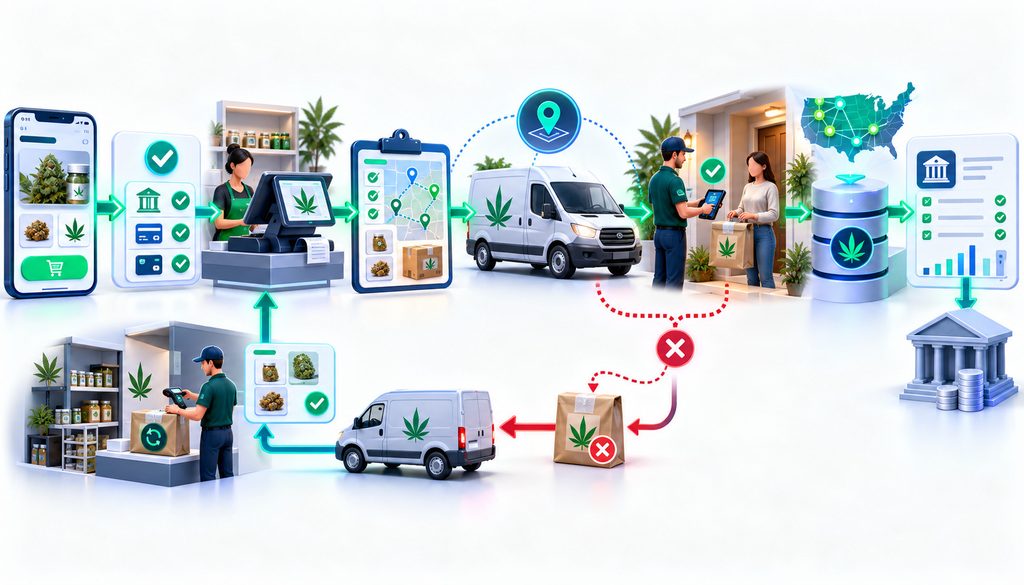
The practical challenge with cannabis delivery payment rules by state is that a payment record is only one part of the transaction. The online order, POS, delivery ledger or manifest, driver’s inventory, state track-and-trace record, and eventual settlement must reconcile according to the particular state’s delivery model.
Use this operational chain:
Online order → payment state → POS → delivery ledger/manifest → driver custody → ID verification → completed or failed delivery → state inventory disposition → settlement → reconciliation
| Record | What Must Match |
| Online order | Customer/order identity, products, quantities, total |
| POS | Sales total, tax, tender, final order status |
| Delivery ledger/manifest | Driver, vehicle, products, destination/order |
| State track-and-trace | Inventory movement and final disposition |
| Driver cash log | Cash actually collected and returned |
| ACH/debit report | Authorized, pending, settled, failed, returned |
| Bank deposit | Funds actually received |
Timing differences matter. An ACH debit can be initiated before final settlement. A cash order can leave the store but fail at the door. A California vehicle may contain lawful unassigned delivery inventory, while Massachusetts and Colorado use order-specific loading rules.
End-of-Day Delivery Reconciliation Checklist
- Count driver cash.
- Compare cash with completed cash orders.
- Review ACH, debit, and other electronic-payment statuses.
- Identify failed and refused deliveries.
- Physically verify returned inventory.
- Correct POS sales and tender records.
- Reconcile state track-and-trace records.
- Review manifest, stop-log, and route exceptions.
- Record and investigate payment or inventory discrepancies.
- Secure or deposit cash according to the approved procedure.
Never change a manifest, tender record, or inventory adjustment simply to make totals balance. Resolve the underlying exception.
Cash Versus ACH for Delivery
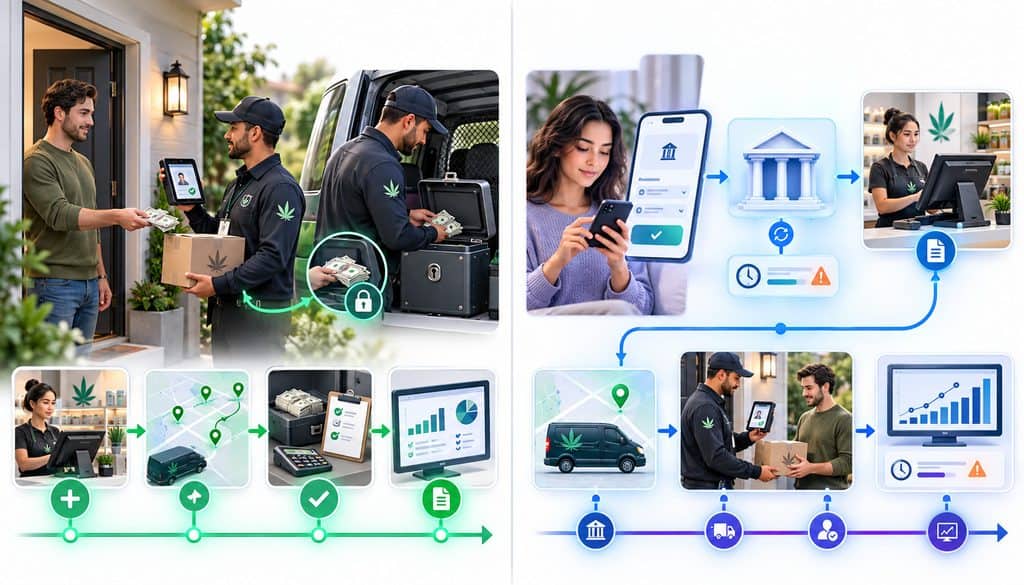
| Issue | Cash at Door | ACH Prepay |
| Vehicle cash exposure | Higher | Lower |
| Door-side delay | Counting/change required | Usually less payment handling |
| Settlement | Immediate once valid cash is accepted | Debit may later return |
| Primary fraud risk | Counterfeit/theft/cash discrepancy | Unauthorized/NSF/account fraud |
| Reconciliation | Driver cash vs completed orders | POS vs ACH status vs bank funding |
| Security benefit | Simple tender | Reduces physical cash, not product-theft risk |
ACH can reduce physical cash exposure. It does not eliminate fraud or the security risk associated with transporting cannabis.
Common Cannabis Delivery Payment Compliance Mistakes
| Mistake | Why It Creates Risk | Better Control |
| Calling California’s $10,000 cap a pre-sold-order cap | California permits dynamic inventory | Separate pre-sold and unassigned inventory correctly |
| Creating California’s delivery ledger after departure | CCTT ledger must exist before trip begins | Generate it pre-departure |
| Treating Michigan’s $5,000 as unrestricted inventory | Only $3,000 may be unordered at departure | Track both limits |
| Claiming Michigan has a 10-stop rule | Current R 420.207 does not contain one | Apply the 30-minute return rule |
| Calling inventory limits driver cash limits | They regulate different risks | Maintain separate policies |
| Treating ACH approval as settlement | Return can occur later | Track lifecycle states |
| Giving the order to any adult at the address | Recipient restrictions vary | Verify the authorized recipient |
| Using disguised ATM/card transactions | Creates acquiring/network risk | Use transparent approved payment arrangements |
Practical Launch Checklist for a New Delivery Program
Before the first route:
- confirm state delivery authority;
- confirm local authorization where applicable;
- confirm which licensee and employees may deliver;
- determine whether inventory may be dynamic or must be order-specific;
- configure all vehicle-value and quantity ceilings;
- configure pre-departure manifest or ledger generation;
- configure GPS and vehicle security;
- obtain written payment-provider approval;
- configure ACH authorization and account validation;
- verify any debit product and its actual transaction type;
- establish cash storage and reconciliation procedures;
- document ID and recipient verification;
- configure failed-delivery handling;
- map returned inventory into state track-and-trace;
- reconcile POS, payments, manifests, and inventory;
- train dispatchers and drivers; and
- test a full order from checkout through settlement.
FAQs
Can a cannabis delivery customer pay cash at the door?
It depends on the jurisdiction. Michigan expressly permits payment upon delivery, Colorado expressly permits payment on delivery, and Massachusetts regulations expressly contemplate vehicle cash. California and Nevada’s reviewed delivery rules do not establish one universal tender method.
Can a dispensary take credit cards for marijuana delivery?
Do not assume conventional card acceptance is available. Marijuana remains Schedule I federally as of September 27, 2026, and network/acquirer approval is separate from state delivery authorization.
Can cannabis delivery orders be prepaid with ACH?
Potentially, when the bank and ACH provider knowingly support the cannabis merchant. Authorization, validation, settlement, and return exposure still need to be managed separately.
Is PIN debit allowed for cannabis delivery?
It may be available through particular acquiring arrangements, but it is not universally available. Verify the actual merchant classification, purchase transaction, acquirer, routing, terminal, and cannabis policy.
How much cash can a cannabis delivery driver carry?
The five reviewed state rules do not establish one shared numeric driver-cash ceiling. Several instead impose cannabis inventory-value or quantity limits.
What happens if the customer cannot pay?
Do not transfer the product. Record the failed delivery, return and reconcile inventory as required, correct the POS, and handle the payment according to whether it was declined, pending, voidable, or refundable.
Can someone other than the person who ordered receive the cannabis?
Do not assume so. Michigan, Nevada, and Colorado expressly impose ordering-recipient requirements in relevant delivery scenarios, and other states have their own recipient-verification rules.
How do payments reconcile with Metrc or another state tracking system?
Payment and inventory systems perform different jobs. The POS, delivery documentation, state inventory record, driver cash or electronic-payment report, and eventual bank settlement should be reconciled rather than treated as one system. Michigan expressly uses Metrc as its statewide marijuana tracking system.
Cannabis Delivery Payment Rules by State: What Operators Should Remember
The most important lesson from cannabis delivery payment rules by state is that payment cannot be designed separately from delivery compliance.
California permits dynamic inventory but requires a CCTT delivery ledger before departure. Michigan allows both preordered and limited unordered inventory, expressly permits payment on delivery, and uses a 5,000/3,000 value structure plus the 15-ounce/60-gram adult-use transport ceiling. Nevada uses customer-specific seed-to-sale manifests and strict recipient controls. Massachusetts requires every product to correspond to an individual order and expressly regulates vehicle cash security. Colorado is order-specific, requires state/local delivery authority, and expressly permits payment on delivery.
Cash at the door can be operationally simple but increases driver cash exposure. ACH prepayment reduces physical cash but introduces return and settlement risk. PIN debit should only be offered through a transparent, knowingly approved acquiring arrangement.
The control objective is:
Order → payment → POS → vehicle inventory → manifest or ledger → legal recipient → state tracking → settlement should all reconcile to the same transaction.
Cannabis delivery and payment rules vary by state, license type, locality, financial institution, and payment provider. Regulations change frequently. Operators should confirm current requirements with the applicable cannabis regulator, their counsel or compliance adviser, and each bank, acquirer, or payment provider before changing delivery-payment procedures.