
By admin August 22, 2026
A dispensary can have a correct customer receipt and still have a compliance problem if the POS sale, package quantity, physical inventory, and state traceability record do not agree.
That distinction is at the heart of METRC compliance and effective Seed-to-Sale Reconciliation at the Register. Completing a transaction at checkout proves that the register processed a sale.
It does not, by itself, prove that the correct regulated package was selected, the proper quantity was deducted, the transaction reached Metrc, or the remaining physical inventory matches the state record.
For retailers operating in jurisdictions that use Metrc, the essential reconciliation chain is:
Physical Product → Package/Tag → POS Item → Register Sale → Inventory Decrement → Metrc/State Traceability Report → Daily Reconciliation → Exception Resolution
Each link needs to remain connected. A problem anywhere in that chain can create a dispensary inventory variance even when the customer experience appears normal.
Metrc requirements are also jurisdiction-specific. For example, Nevada identifies Metrc as its seed-to-sale tracking system, and Massachusetts requires licensed marijuana establishments to maintain seed-to-sale tracking through Metrc.
But individual rules concerning sales entry, package handling, corrections, returns, adjustments, reporting deadlines, and other workflows differ by jurisdiction.
This guide therefore focuses on a defensible operational framework rather than pretending that one state’s procedure applies everywhere. Retailers should compare each workflow with their current regulator rules, Metrc market configuration, and approved POS integration before changing records.
Compliance disclaimer: This article is educational and does not constitute legal, tax, regulatory, or individualized compliance advice. Cannabis businesses should verify current requirements with their state cannabis regulator, applicable regulations, official Metrc guidance, and qualified professional advisers.
What Is Metrc and Seed-to-Sale Tracking?
Seed-to-sale tracking creates a regulatory record of cannabis as it moves through licensed cultivation, processing, testing, transportation, retail inventory, and ultimately sale or other authorized disposition.
Metrc is one platform used by numerous cannabis regulatory programs for this purpose. Its system can associate regulated inventory with serialized plant or package identifiers and record events such as transfers, package creation, inventory changes, and retail sales.
Metrc describes its platform as tracking cannabis through stages including growth, harvest, processing, testing, transport, and sale.
However, Metrc is not the same thing as a dispensary POS.
The POS is primarily the retailer’s operational transaction system. It handles activities such as product lookup, barcode scanning, customer checkout, discounts, payments, taxes, receipts, staff permissions, and internal inventory.
A retailer evaluating or configuring its technology should therefore pay particular attention to the POS system’s inventory and seed-to-sale integration capabilities; this guide to choosing a cannabis dispensary POS system discusses those operational considerations in more detail.
The state traceability system has a different purpose. It creates the regulated inventory record visible to the regulator.
That difference explains why reconciliation is essential. A register can show that five units were sold while Metrc shows four, or the two systems can agree while a physical count shows only three units remaining.
None of those records should automatically be treated as the unquestioned source of truth without investigating the underlying transactions and physical product.
POS vs. Metrc vs. Physical Inventory vs. Accounting
Cannabis inventory reconciliation becomes much easier when a retailer stops expecting one system to answer every operational question.
The POS, state traceability platform, physical inventory, and accounting system contain overlapping information, but they serve different purposes. They may also update at different times or use different identifiers.
| System | Primary Purpose | What It Should Tell You |
| POS | Retail operations | What was sold, when, by whom, at what price, and from which SKU/package where supported |
| Metrc/state traceability | Regulatory inventory tracking | What regulated packages exist, their reported quantities, and reportable activity affecting them |
| Physical inventory | Actual product control | What cannabis products are physically present at the licensed premises |
| Accounting system | Financial reporting | Revenue, taxes, payment activity, expenses, cash, receivables, and general-ledger balances |
A dispensary POS may show 18 units remaining because its internal stock count decreased correctly after each checkout. Metrc could show 19 because one sale failed to transmit. A shelf count could reveal only 17 because one item was damaged but never reported and another was accidentally taken from a different package.
The accounting ledger might still show the correct revenue because all customer payments were captured.
That example illustrates why cannabis inventory reconciliation and financial reconciliation are related but not interchangeable.
Product reconciliation asks:
Physical Quantity ↔ POS Quantity ↔ Metrc Quantity
Financial reconciliation asks:
POS Sales ↔ Cash/Payment Methods ↔ Deposits/Bank Activity ↔ General Ledger
A retailer should investigate both, but a balanced cash drawer does not prove that package inventory is correct.
Conversely, perfect Metrc quantities do not prove that revenue, tax, cash, ACH, or other payment records have been posted correctly.
What Does METRC Reconciliation at the Register Mean?

METRC Reconciliation at the Register means confirming that legitimate retail activity recorded at checkout is accurately represented throughout the dispensary’s inventory and state-reporting chain.
At a minimum, a retailer should be able to connect the transaction to the correct product, regulated package, quantity, unit of measure, transaction status, and state traceability event.
A useful point-of-sale METRC reconciliation process asks:
- Was a real sale completed?
- Was the correct SKU selected?
- Was the correct source package selected?
- Was the correct quantity sold?
- Did the POS decrement that package correctly?
- Was the transaction submitted to the required state traceability system?
- Was it accepted rather than merely queued?
- Did Metrc deduct from the correct package?
- Was the sale later voided or refunded?
- Does the remaining physical quantity support the electronic records?
This is more than comparing daily dollar totals.
Two systems can show $10,000 in sales while still disagreeing package by package. Similarly, two systems can report the same number of products sold while assigning those sales to different package IDs.
A strong daily sales reconciliation therefore works at the lowest practical regulated-inventory level. For many dispensaries, package ID is the critical field.
The goal is not simply to force the totals to match. It is to identify why they do not match and use the regulator-authorized correction process when a correction is genuinely required.
How a Cannabis Sale Should Flow From Package to State Record

A typical dispensary sale follows an operational path resembling:
Scan/Select Product → Verify Package/SKU → Complete Sale → POS Reduces Inventory → Required Sales Data Sent/Reported → Metrc Package Quantity Updates → Daily Exception Review
The exact timing and technical method differ by jurisdiction and POS provider. Some retailers use API-based integrations. Others may use file-based or manual processes permitted by their regulators.
A useful example comes from the Massachusetts Cannabis Control Commission’s seed-to-sale tracking guidance, which states that retailers can enter sales through an API, CSV file, or manual upload and should work with their POS provider on available functionality. This is a Massachusetts-specific workflow rather than a universal Metrc rule.
Massachusetts, for example, states that retailers can enter Metrc sales using an API, CSV file, or manual upload and advises retailers to check their POS provider’s functionality. The same guidance makes clear that the licensee remains responsible for accurate seed-to-sale records.
That distinction matters when evaluating POS and Metrc integration.
A software interface may successfully send hundreds of transactions automatically, but one transaction can still fail because of an invalid package, unit mismatch, unavailable service, expired credential, data validation problem, or integration defect.
For that reason, completion at the register should produce two operational questions:
- Did the customer transaction complete correctly?
- Did the corresponding regulated inventory event complete correctly?
The answer can be yes to the first and no to the second.
A well-designed cannabis POS inventory tracking process preserves enough transaction information to investigate that difference without forcing staff to reconstruct the sale manually from memory.
Retailers configuring a new system should test this entire lifecycle rather than only confirming that the register can ring up products. This POS setup guide for marijuana stores highlights the importance of inventory and state-reporting integration during system configuration.
POS and Metrc Integration: Automation Does Not Eliminate Compliance Responsibility
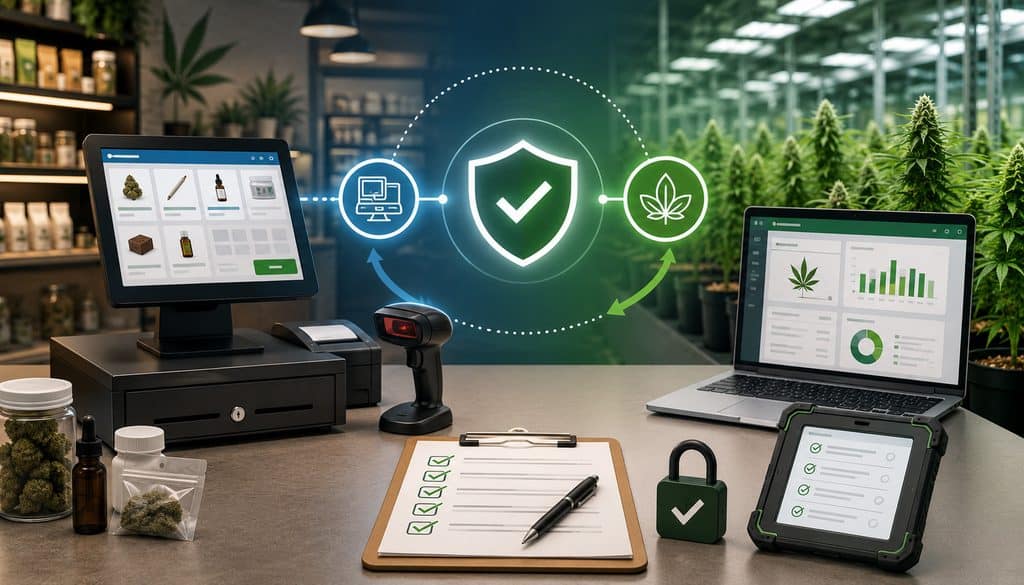
A dispensary may encounter several technical models for matching dispensary sales to Metrc.
A direct integration can allow the POS vendor to communicate with Metrc through authorized API functionality. A middleware provider may sit between the POS and regulatory platform. Other workflows can rely on scheduled reporting, CSV uploads, or manual entry where the jurisdiction permits it.
Regardless of architecture, the retailer needs visibility into what happened after the transaction left the register.
An integration should ideally preserve:
- POS transaction ID
- timestamp
- package identifier
- item/SKU
- quantity and unit
- reporting status
- state or API response
- retry status
- error message
- void/refund status
- submitting user or system
- final confirmation
Metrc’s API documentation includes package, adjustment, sales, and other regulatory-data operations, illustrating that state reporting involves structured data rather than merely copying a daily register total.
A dispensary evaluating an integrated technology stack should also understand which company is responsible for which component. A guide to integrating cannabis POS and merchant-service systems can help retailers distinguish POS, payment, inventory, and system-integration functions.
Most importantly, the phrase “Metrc-integrated” should never be interpreted as “compliance is automatic.”
Massachusetts specifically warns licensees that if inventory is uploaded through a third-party API, the licensee must ensure that the figures reflect accurate inventory.
Package Tag Tracking: The Foundation of Cannabis Inventory Reconciliation
Package tag tracking is one of the most important controls in dispensary traceability reconciliation.
The customer may think in product names such as “3.5-gram flower jar” or “10-pack gummies.” The POS may identify that retail item through a SKU. But the regulatory system needs to know which traceable package supplied the product.
That source package matters because regulated inventory is not interchangeable merely because two products look identical.
Package controls should follow the licensed jurisdiction’s requirements. For example, Massachusetts’ official seed-to-sale tracking requirements describe its use of serialized plant and package tags in Metrc and place responsibility on licensees for maintaining sufficient tags for inventory reconciliation and tracking.
SKU vs. Package ID
A SKU identifies a retail product configuration, while a package ID identifies regulated inventory.
For example, a store may use the SKU FLOWER-BD-35 for every 3.5-gram Blue Dream jar. During a month, the dispensary could receive several batches of that same retail product under different Metrc packages.
The SKU can therefore remain the same while the source package changes.
If Package A has two units remaining and Package B has 40, but the register remains mapped to Package A after employees begin physically selling Package B, the POS may process every customer transaction correctly from a retail perspective while the state record becomes inaccurate.
The resulting symptoms can include:
- negative or unexpectedly low electronic inventory;
- excess physical inventory associated with one package;
- shortage associated with another package;
- package closure at the wrong time;
- sales associated with an inactive package;
- difficult audit reconstruction.
The solution is not to treat SKU and package ID as interchangeable fields.
A reliable package mapping design needs a method to identify which physical inventory is currently being sold and ensure the register draws from that same regulated package.
Multiple Open Packages
Multiple open packages increase complexity because employees may have more than one regulatory source available for the same retail item.
A retailer should establish a consistent policy for package selection that fits its regulator’s rules and operational model. For example, the store may intentionally deplete one package before activating another at the sales floor, where permitted and operationally appropriate.
Useful controls include clearly identifying active sales-floor packages, limiting who can remap packages, scanning package-linked labels, and requiring staff to escalate uncertainty rather than selecting whichever package appears first in the POS.
Physical organization matters as much as software configuration.
If two open packages of the same item are stored together without clear identifiers, a technically correct POS mapping can become wrong the moment an employee picks product from the other container.
Massachusetts describes Metrc as using serialized plant and package tags and emphasizes sufficient tag availability for ongoing inventory tracking.
Daily Sales Reconciliation: A Practical Register-to-Metrc Workflow
Daily dispensary closeout should include more than cash counting and payment totals. The compliance portion should test whether POS transactions, package activity, state-reported sales, and regulated inventory remain aligned.
A practical daily sales reconciliation workflow is:
- Close or review register activity: Confirm all shifts and registers have completed their normal close procedures.
- Export sales detail: Include transaction IDs, SKUs, package IDs, quantities, units, timestamps, and status fields where available.
- Identify voids, refunds, and canceled transactions.
- Review integration exceptions: Separate successful, pending, failed, and retried submissions.
- Compare POS quantities sold to state-reported quantities.
- Calculate expected package balances.
- Compare against Metrc package quantities.
- Perform physical checks for selected packages or exceptions.
- Investigate differences before adjusting anything.
- Make only authorized corrections under the applicable jurisdiction’s procedure.
- Document the root cause and supporting evidence.
- Verify the systems agree after the correction.
This process supports both daily sales reconciliation and longer-term cannabis audit preparation.
A retailer does not necessarily need to manually recount every product every night unless its regulator requires that procedure. The point is to build a disciplined exception process and supplement transaction reconciliation with appropriate physical counts.
Example Daily Reconciliation Table
The following example uses hypothetical quantities only.
| Package ID | Product | Opening Qty | POS Sold | State-Reported Sold | Expected Qty | Physical Qty | Variance |
| PKG-A101 | Flower 3.5 g | 30 | 8 | 8 | 22 | 22 | 0 |
| PKG-B225 | Gummies 10-pack | 40 | 11 | 10 | 29 | 29 | State report short 1 |
| PKG-C318 | Vape 1 g | 25 | 6 | 6 | 19 | 18 | Physical short 1 |
| PKG-D442 | Pre-roll | 60 | 12 | 13 | 48 | 48 | State report over 1 |
The table immediately reveals different root-cause possibilities.
Package B may have a missing or pending state submission. Package C may involve a physical inventory issue, damage, mis-pick, or an event not yet recorded. Package D could indicate duplicate reporting.
None should automatically receive the same inventory adjustment.
Point-of-Sale Data Matching and Unit-of-Measure Controls
Point-of-sale data matching works best when the retailer can compare the same identifiers and units across systems.
Commonly useful matching fields include:
- transaction or receipt ID;
- sale date and time;
- package ID;
- SKU or item ID;
- product description;
- quantity;
- unit of measure;
- register;
- employee;
- sale status;
- void or refund status;
- integration status;
- state-reporting reference, where available.
Transaction ID and package ID are especially valuable because aggregate totals can hide individual errors.
Unit-of-Measure Problems
Unit mismatches are a frequent source of cannabis inventory reconciliation problems.
A product could be represented as individual units in one system and weight in another. A configuration error may convert one retail unit into the wrong regulated quantity. Weight-based products can introduce additional challenges involving scale precision and legitimate measurement differences.
Retailers should not invent their own tolerance or rounding rule. Exact requirements depend on the jurisdiction, product type, system configuration, and applicable weights-and-measures requirements.
Before changing a conversion factor, verify:
- the Metrc item category;
- package unit of measure;
- POS selling unit;
- conversion configuration;
- actual package label;
- regulatory requirements;
- previous transactions using the same mapping.
Weight-Based and Packaged Unit Products
Weight-based products require particular attention because a small conversion error repeated across dozens of sales can create a substantial cumulative variance.
Suppose the POS is configured to decrement 3.50 grams for a particular sale while the state integration submits a differently calculated quantity. Repeated transactions can gradually separate the systems even though every customer receives the intended product.
Unit-based products are not immune.
A package of 50 vape cartridges should be easier to reconcile than bulk flower, but the retailer can still create a discrepancy by selecting the wrong package, duplicating a sale, handling a return incorrectly, or prematurely closing the source package.
Common Causes of POS-to-Metrc Discrepancies
Most discrepancies fit into a limited number of operational categories, which makes root-cause analysis faster when the store tracks recurring patterns.
Common causes include:
- wrong package selected at checkout;
- SKU mapped to the wrong package;
- sale not transmitted;
- rejected state submission;
- integration delay;
- duplicate sales report;
- blind retry after a timeout;
- void not reflected in state data;
- return treated incorrectly;
- incorrect unit conversion;
- unauthorized manual adjustment;
- physical count error;
- unrecorded damage or waste;
- transfer received incorrectly;
- package closed prematurely;
- API or middleware outage;
- employee selection error.
Integration Delay vs. a True Inventory Error
A synchronization delay should not automatically be treated as shrinkage.
Imagine the POS shows ten units sold, Metrc temporarily shows nine, and the physical package quantity corresponds with ten actual sales. Before creating an adjustment, the retailer should check whether one submission remains queued or whether an API request was accepted but its local status was not updated.
Making an inventory adjustment while the original sale is still waiting to post can create another error when that sale eventually reaches Metrc.
A safer sequence is to check the receipt, package ID, submission status, timestamps, integration logs, and state record before modifying inventory.
Duplicate Reporting and Retry Logic
Duplicate reporting can occur when a system does not know whether a timed-out request succeeded and submits the same activity again.
Reliable integrations should use available identifiers and duplicate-prevention controls so that uncertain network responses do not automatically create repeated regulatory transactions.
Metrc previously issued guidance specifically acknowledging API-related discrepancies, including duplicate sales entries and conversion errors, while emphasizing that third-party systems should address issues appropriately rather than using adjustments indiscriminately.
Retailers should verify the final state record before resubmitting an uncertain transaction.
Never delete, conceal, or offset legitimate activity merely to make a dashboard look balanced.
Voids, Refunds, Returns, Discounts, and Taxes
Post-sale events are especially important because financial treatment and regulated-inventory treatment are not always identical.
Voids at the Register
A canceled transaction that never completed may have no reportable inventory movement. By contrast, correcting a completed sale that has already been transmitted can require a specific traceability action.
The difference is determined by transaction status and applicable state procedure, not by whether the POS button says “void.”
Massachusetts guidance provides a useful example of jurisdiction-specific treatment: when retailers need to correct duplicated sales or sales recorded under an incorrect package ID, the Commission instructs them to void or edit receipts individually and reconcile Metrc and the POS within its specified timeframe. That instruction is specific to Massachusetts and should not be assumed to apply identically elsewhere.
Refunds and Returns
A financial refund does not automatically mean cannabis should be restored to saleable inventory.
The customer can receive money back while the physical product follows a regulated return, quarantine, waste, or destruction procedure.
Massachusetts, for example, states in its retailer guidance that a patient return cannot be resold and must be handled as waste under the applicable process.
Other jurisdictions can differ.
The correct workflow therefore asks two separate questions:
- What should happen financially?
- What should happen to the regulated product?
Discounts, Promotions, and Taxes
Discounts generally change the financial value of a transaction rather than the physical amount of cannabis that left inventory.
If one unit was sold, the package quantity should not become inaccurate simply because the customer received a promotion. The retailer must nevertheless comply with jurisdiction-specific promotion and pricing rules.
Similarly, the POS commonly performs tax and financial calculations while Metrc primarily serves the regulated product-traceability function.
Metrc should not be treated as a substitute for accounting books or required tax records.
Cannabis Inventory Adjustments and Lawful Discrepancy Resolution
Inventory adjustments have legitimate purposes, but they should not become the default solution whenever numbers disagree.
Potential legitimate situations can include count corrections, damage, waste, destruction, documented loss, or other jurisdiction-recognized events. The adjustment reasons available, required notes, approvals, deadlines, and regulator notifications vary by market.
Metrc’s current correction guidance notes that package quantity adjustments require an adjustment reason and explanatory note and also warns that features differ across markets, so licensees should refer to their state rules and Metrc configuration.
That is the right mindset for inventory discrepancy resolution.
A Structured Discrepancy Workflow
When a variance appears:
- Identify the affected package.
- Stop unnecessary manual adjustments.
- Confirm the physical package and tag.
- Review its opening quantity.
- Compare POS transaction history.
- Compare state traceability activity.
- Review voids and refunds.
- Review transfers and package creation.
- Check waste, damage, or destruction records.
- Examine integration logs.
- Determine the root cause.
- Apply only the authorized correction.
- Record who corrected it and why.
- Verify the final POS, Metrc, and physical quantities.
Useful root-cause categories include:
- physical inventory issue;
- POS entry or mapping issue;
- integration issue;
- state-reporting issue;
- transfer/package issue;
- legitimate waste/loss event.
Never Use Adjustments to Hide Poor Reconciliation
Repeatedly “zeroing out” discrepancies without investigation weakens the seed-to-sale audit trail.
An adjustment may make today’s quantity appear correct while leaving the organization unable to explain how the difference occurred.
The better record tells the full story:
Original Event → Detected Variance → Supporting Evidence → Authorized Correction → Verified Final Balance
Documentation may include the transaction reference, package ID, quantity, reason, employee, correction timestamp, manager approval, relevant system logs, and regulator or Metrc support correspondence when appropriate.
Physical Inventory Counts: Metrc Quantity Is Not Proof of Physical Quantity
Electronic inventory is a record of what the system believes should exist.
It is not physical proof that the product is actually on the shelf, in the vault, or in the designated package.
That is why a sound control framework uses:
Physical Quantity ↔ POS Quantity ↔ Metrc Quantity
If all three match, confidence increases. If one differs, the package becomes an exception requiring investigation.
Nevada’s regulator provides a useful current example of this distinction. Its materials describe inventory reconciliation and Metrc inventory counts as supporting information in compliance workflows, while current regulator training specifically addresses physical accountability, package-level reconciliation, POS records, adjustments, and sales reporting.
Cycle Counts
Cycle counting allows retailers to physically verify selected inventory more frequently without performing a complete store count every time.
High-volume, high-value, frequently adjusted, or historically problematic packages are reasonable operational candidates for more frequent review, unless the regulator establishes a different mandatory process.
A useful cycle count compares:
- physical quantity;
- POS quantity;
- Metrc quantity;
- recent package activity;
- unresolved exception history.
Full Inventory Counts
Full counts can expose cumulative problems that transaction-level reconciliation misses.
A one-unit difference that appears insignificant can reveal repeated package-selection errors when similar variances appear across several packages. Weight discrepancies may likewise accumulate gradually.
Retailers should use the schedule required by their jurisdiction and supplement it with risk-based internal counting where useful.
Do not assume that an internal count schedule replaces any regulator-mandated inventory requirement.
Seed-to-Sale Reporting Deadlines, Outages, and Integration Errors
There is no single national Metrc reporting deadline for every dispensary.
Reporting frequency, timing, outage procedures, correction windows, and required documentation come from state rules and regulator guidance.
That point deserves emphasis because outdated articles frequently state a number of hours as though it applies everywhere.
For example, Massachusetts publishes specific retailer correction guidance, while Nevada maintains its own reporting and inventory requirements. The procedures cannot safely be merged into one universal rule.
Before relying on any reporting deadline, verify it against the current regulator source for the licensed jurisdiction.
What Happens During a Metrc or State Reporting Outage?
During an outage, the goal is to preserve complete local records and follow the jurisdiction’s official contingency process.
Depending on the regulator and system configuration, operational concerns can include:
- preserving queued transactions;
- recording timestamps;
- retaining package-level sale detail;
- distinguishing submitted from unsent records;
- preventing duplicate resubmission;
- documenting the outage period;
- reconciling after service restoration.
Do not create an unofficial offline workflow merely because it seems operationally convenient.
Integration Error Handling
A defensible integration-error process is:
- preserve the failed transaction;
- record its error or pending status;
- determine whether it reached Metrc;
- avoid blind duplicate submission;
- identify mapping or validation problems;
- correct the underlying issue;
- resubmit only through an authorized process;
- verify the final state record.
API and middleware providers should support transaction identifiers, timestamps, controlled retry behavior, error queues, monitoring, and audit logs.
These controls make it easier to distinguish a network uncertainty from a genuine missing transaction.
Cannabis Audit Preparation and Building a Seed-to-Sale Audit Trail
Cannabis audit preparation should begin long before an inspector arrives.
A retailer should be able to reconstruct the movement of regulated inventory through logical records rather than relying on employee memory.
A useful audit trail follows:
Opening Inventory → Receipts/Transfers → Retail Sales → Returns/Waste/Adjustments → Ending Inventory
Supporting records should allow investigators and managers to understand why each package quantity changed.
Conceptually, regulators may be interested in areas such as package history, accurate sales reporting, transfer records, physical inventory, documented adjustments, and supporting POS activity. Exact inspection scope depends on the jurisdiction.
Nevada’s current Metrc retail training, for example, includes audits and inspections, inventory reconciliation, POS records, package-level accountability, adjustments, sales reporting, and documentation.
POS Audit Logs and User Permissions
POS audit logs are valuable for understanding who performed sensitive activity.
Useful logs can cover:
- completed sales;
- voids;
- refunds;
- discounts;
- inventory edits;
- package reassignment;
- manual overrides;
- user sign-ins;
- configuration changes.
Historical events should not be overwritten simply to produce a cleaner report.
User permissions should also follow least-privilege principles. Employees who only ring sales generally do not need unrestricted authority to adjust packages, alter integrations, delete transactions, or change reporting configuration.
NIST describes least privilege as limiting user access to functions necessary for assigned responsibilities and reviewing privileges periodically.
Sensitive functions worth restricting include:
- package mapping;
- cannabis inventory adjustments;
- refund and void authorization;
- reporting configuration;
- integration credentials;
- administrative changes.
Budtender Training, Manager Closeout, and Weekly Compliance Review
Technology cannot compensate for unclear procedures at the register.
Budtenders frequently make the final connection between the physical product and the electronic package, so training should focus on the actions most likely to affect package accuracy.
Staff should know how to:
- identify the correct package;
- confirm SKU/package mapping;
- recognize a package switch;
- avoid unapproved manual workarounds;
- report integration errors;
- follow void and return procedures;
- escalate uncertain inventory;
- avoid changing quantities merely to make systems match.
Managers need a complementary closeout routine.
A daily manager review should include POS sales totals, package-level exceptions, failed integrations, voids, refunds, unusual discounts, inventory changes, relevant spot counts, unresolved discrepancies, and required state reporting.
Weekly review should then look for patterns rather than individual mistakes.
Useful trend questions include:
- Does one product repeatedly show variance?
- Does one register generate more reporting errors?
- Are package switches causing recurring mismatches?
- Are failures associated with one integration?
- Are particular employees generating unusual override activity?
- Are delayed submissions increasing?
- Are adjustments concentrated in one product category?
Repeated small discrepancies often deserve more attention than a single well-documented correction because repetition can indicate a process defect.
POS, Metrc, and Accounting Reconciliation Must Remain Separate
Dispensaries often combine several end-of-day activities under the word “reconciliation,” but two distinct control layers are involved.
Product reconciliation compares:
POS ↔ Metrc ↔ Physical Inventory
It answers questions about cannabis quantity, package identity, transfers, sales, waste, and adjustments.
Financial reconciliation compares:
POS Sales ↔ Payment Methods ↔ Cash/Bank Activity ↔ General Ledger
It answers questions about revenue, payment collections, taxes, deposits, and accounting.
Imagine the POS records a $50 sale from the wrong Metrc package. The customer pays $50 cash and the drawer balances exactly.
Financial reconciliation passes.
Product reconciliation fails.
Now imagine the correct package is reported to Metrc, but the cashier enters the wrong payment tender and creates a cash shortage on the books.
Product reconciliation can pass while financial reconciliation fails.
Keeping these layers separate improves both compliance and accounting accuracy.
Cash, card, ACH, or other permitted payment totals should therefore be reconciled independently from package quantities. The payment method does not determine whether the correct regulated inventory package was decremented.
Common METRC Reconciliation Mistakes to Avoid
Many cannabis inventory errors come from a small group of assumptions.
The most common is believing that an integrated POS eliminates the need for review.
Others include:
- treating SKU and package ID as the same identifier;
- leaving outdated package mappings active;
- opening multiple packages without a selection control;
- closing packages before transactions are fully reconciled;
- retrying uncertain submissions without checking state status;
- failing to reconcile voids;
- treating every refund as a return to saleable inventory;
- ignoring unit conversions;
- using unsupported manual adjustments;
- failing to investigate recurring small variances;
- mixing financial and regulatory reconciliation;
- assuming Metrc quantity proves physical inventory;
- using outdated state guidance.
Another mistake is correcting only the symptom.
If three employees repeatedly sell from the wrong package, adjusting inventory every evening does not solve the problem. The store needs to fix package organization, POS mapping, training, permissions, or all four.
Metrc’s own correction guidance specifically advises users to consider the rules and configuration of their market because not every feature operates identically in every jurisdiction.
That principle should guide the entire compliance program: verify first, then correct.
Metrc Reconciliation Checklist
The following checklist can serve as a daily or periodic review framework. It should be adapted to the retailer’s current jurisdiction-specific obligations.
| Area | What to Verify |
| Correct package/SKU mapping | POS product points to the correct physical regulated package |
| Opening package quantity | Starting balance agrees with prior verified close |
| POS quantity sold | Completed sales are counted accurately |
| State-reported quantity sold | Required sale records reached Metrc/state system |
| Physical quantity | Product physically present supports electronic balance |
| Voids/returns | Financial and regulatory treatment is correct |
| Waste/adjustments | Authorized reason, quantity, and documentation exist |
| Transfer activity | Received/transferred packages agree with actual product |
| Integration failures | Failed or pending transactions are investigated |
| Duplicate submissions | Retries did not duplicate legitimate sales |
| User actions | Overrides and sensitive changes have accountable users |
| Required reporting complete | Current jurisdiction deadlines have been satisfied |
| Variances documented | Root cause and correction evidence are retained |
A zero-variance report is useful, but it should not be the only measure of compliance quality.
A store with occasional documented exceptions, strong root-cause analysis, and a reliable audit trail may have a much healthier reconciliation process than a store that constantly adjusts inventory until every dashboard displays zero.
Questions to Ask Your POS or Integration Provider
Before relying on a POS and Metrc integration, retailers should understand exactly how regulatory data moves.
Ask the provider:
- How are POS items mapped to Metrc packages?
- Can one SKU be associated with multiple active packages?
- How does an employee know which package is being sold?
- When are completed sales transmitted?
- How are failed submissions displayed?
- How are pending transactions distinguished from rejected ones?
- How are retries handled?
- How does the integration prevent duplicates?
- What happens after an API timeout with an unknown result?
- How are voids handled after transmission?
- How are refunds and returned products represented?
- Can package-level sales be exported?
- Are integration logs retained?
- Can managers identify which employee selected or changed a package?
- What happens during a Metrc outage?
- How does the system reconcile quantities daily?
- Which state-specific workflows are currently supported?
- How are regulatory changes incorporated?
- How are software releases tested against state requirements?
- What records remain available if the integration is temporarily unavailable?
Do not accept “fully compliant” as a substitute for technical answers.
The stronger response explains what data is transmitted, when it is transmitted, how failures appear, what the retailer must do when something goes wrong, and which functions vary by state.
Frequently Asked Questions
What Is Metrc Compliance?
Metrc compliance means using the state-required Metrc workflows accurately within the rules established by the applicable cannabis regulator. It can involve maintaining package and inventory records, recording required sales or transfers, documenting adjustments, and preserving an accurate traceability history.
Compliance should not be defined simply as “having a Metrc account” or “using an integrated POS.” The underlying records must reflect actual regulated activity.
Requirements vary by jurisdiction. Nevada currently identifies Metrc as its state seed-to-sale system, while Massachusetts likewise uses Metrc for licensed marijuana establishments. Their detailed operating rules are not identical.
Always use the regulator’s current rules when determining the required procedure.
What Is Seed-to-Sale Reconciliation?
Seed-to-sale reconciliation is the process of comparing regulated product movement with the business systems and physical inventory that should support it.
At retail, this commonly means checking:
Physical Product → Package ID → POS Sale → Inventory Reduction → State Traceability Record → Remaining Quantity
A reliable reconciliation process verifies not only total sales but also the package from which product was sold, quantity, unit, transaction status, and eventual state-reporting outcome.
When records disagree, the retailer investigates the source before making corrections.
That investigation is important because the same variance could result from a failed API transaction, wrong package mapping, physical loss, duplicate report, unit error, or improperly handled return. Different causes can require different responses.
How Does a Dispensary POS Connect to Metrc?
A dispensary POS can interact with Metrc through an authorized API integration, middleware layer, file-based workflow, or other state-permitted reporting method. The exact method depends on the POS provider and jurisdiction.
Massachusetts states that retailers can use an API, CSV, or manual upload for sales reporting and recommends confirming available functionality with the POS provider.
Even when reporting is automated, the store needs access to transaction status and integration errors. A good integration should help managers determine whether a sale was submitted, accepted, rejected, retried, or remains pending.
Retailers should test those exception paths before relying on the integration operationally.
Is a Metrc-Integrated POS Automatically Compliant?
No. Integration is a technical capability, not a guarantee of regulatory compliance.
An integrated POS can still send the wrong package ID, submit an incorrect quantity, use a bad unit conversion, duplicate a transaction, or fail to transmit a sale. Employees can also select the wrong product or package before the integration ever becomes involved.
Massachusetts explicitly tells licensees using third-party API uploads to ensure that submitted figures reflect accurate inventory.
Retailers therefore need daily exception monitoring, physical inventory controls, staff training, and state-specific procedures in addition to software integration.
The licensee should understand which duties belong to the POS vendor and which remain the retailer’s responsibility.
What Is a Metrc Package Tag?
A Metrc package tag is a serialized identifier associated with regulated cannabis inventory in the traceability system.
The tag helps maintain the relationship between physical inventory and its regulatory history. Package identifiers can be relevant to sales, transfers, adjustments, testing status, package creation, and other controlled events depending on the jurisdiction.
Massachusetts describes its Metrc system as using serialized plant and package tags to track cannabis through the regulated supply chain. Retail employees should not think of a package tag merely as a warehouse label. At the register, the package identity determines which regulated inventory should decrease when a product is sold.
Incorrect package selection can therefore create a compliance variance despite a correct customer receipt.
What Is the Difference Between a SKU and a Package ID?
A SKU generally identifies the retail item a business sells. A package ID identifies the specific regulated inventory source recognized by the traceability system. One SKU can potentially be associated operationally with different regulated packages over time.
For example, a retailer may sell the same gummy product for months using one SKU while receiving multiple batches under separate package IDs. When the first package is depleted, the POS must begin drawing inventory from the appropriate subsequent package according to the retailer’s controlled workflow.
If employees physically sell from Package B while the POS still reports Package A, total product sales can look correct while package-level inventory becomes inaccurate. That is why package ID should remain a central reconciliation field.
How Do You Reconcile POS Sales With Metrc?
Start with transaction-level or package-level data rather than only comparing daily revenue. Export completed POS transactions with package ID, SKU, quantity, unit, timestamp, receipt ID, and status. Then compare the quantities sold against Metrc sales and remaining package balances.
Next, review failures, retries, voids, refunds, transfers, waste, and adjustments. For any variance, check the physical product and integration logs before changing inventory.
The goal is to establish:
Opening Package Quantity − Valid Sales − Other Authorized Reductions + Authorized Additions = Expected Ending Quantity
Then compare the expected ending quantity with both Metrc and physical inventory. Any difference becomes an exception requiring documented investigation.
Why Does POS Inventory Differ From Metrc Inventory?
The difference can result from package mapping, reporting failures, delayed integrations, duplicate submissions, unit conversions, manual adjustments, transfers, voids, returns, physical inventory problems, or staff errors.
Do not assume the POS is wrong simply because Metrc differs, and do not assume Metrc is wrong because the shelf count differs.
First identify when the balances separated.
Transaction history, package activity, timestamps, integration logs, physical counts, and user audit logs can often narrow the cause.
A temporary submission delay requires a different response from actual shrinkage. Likewise, a duplicate regulatory sale should not be “fixed” using the same procedure as damaged physical product.
Identify the root cause before choosing the correction.
How Often Should Dispensaries Reconcile Inventory?
Retailers should follow every reconciliation and inventory-count frequency required by their jurisdiction and then use additional internal controls based on operational risk.
Daily transaction reconciliation is valuable because it catches package errors while receipts, shifts, employees, and integration events are still easy to investigate.
Physical counting can include risk-based cycle counts plus full counts at intervals required by state rules or internal policy.
Do not rely on a generic nationwide schedule.
Cannabis regulators use different requirements, and those requirements can change. Nevada, for example, publishes its own inventory and reporting processes, while other Metrc states use different requirements and timelines.
Verify the current rule for every licensed location.
What Should a Store Do When a Metrc Sale Fails to Transmit?
Preserve the original POS transaction and determine its actual state-reporting status before submitting anything again. Check the transaction ID, package ID, timestamp, integration response, error message, retry queue, and corresponding Metrc record.
The key question is whether the transaction was genuinely rejected or whether the POS simply failed to receive confirmation. Blindly resubmitting an uncertain transaction can create duplicate reporting.
Once the retailer identifies the failure, correct the underlying data or integration problem and use the authorized resubmission or correction workflow for that jurisdiction.
Finally, verify that the state record reflects the intended sale and document the exception for later reconciliation and audit purposes.
How Should Duplicate Metrc Sales Reports Be Handled?
First verify that the duplicate really represents the same underlying sale. Compare receipt numbers, timestamps, package IDs, quantities, and transaction references.
Then follow the regulator’s permitted correction procedure. Do not invent an offsetting inventory adjustment or delete unrelated activity simply to restore the quantity.
Metrc has historically recognized API duplicate sales entries as a type of integration discrepancy, while its current correction guidance stresses that state-specific configurations and rules must be considered.
Some jurisdictions publish specific procedures for editing or voiding sales. Use the instructions that currently apply to the licensed market and preserve documentation explaining why the correction was necessary.
How Do Voids and Refunds Affect Metrc?
The answer depends on whether the sale was completed and reported, what happened to the physical cannabis, and which state rules apply. A transaction canceled before completion may differ from a sale that reached Metrc and was later financially refunded.
Likewise, returning money to the customer does not automatically return the cannabis to saleable inventory. Massachusetts provides an example of a jurisdiction where patient returns cannot simply be resold and instead require regulated waste treatment.
Other jurisdictions may use different rules.
Retailers should therefore connect refund and void workflows to both financial records and required traceability actions rather than assuming the POS’s financial reversal automatically performs the correct compliance action.
Can a Dispensary Manually Adjust Inventory to Match Metrc?
A dispensary should use inventory adjustments only when the adjustment is truthful, authorized, supported by the applicable adjustment reason, and permitted under current state requirements.
An unexplained difference is not itself sufficient justification to choose an arbitrary adjustment. Metrc’s correction guidance notes that package adjustments require appropriate reasoning and notes and advises users to consult the rules and configuration of their market.
Repeatedly changing quantities simply to force Metrc, the POS, and physical inventory to match can hide the cause of a control failure. Investigate first, preserve supporting records, use the regulator-approved correction process, and verify the resulting balance afterward.
What Records Help Prepare for a Cannabis Inventory Audit?
Useful records can include package histories, POS transaction detail, transfer documents, inventory counts, waste and destruction records, adjustment documentation, void and refund records, employee audit logs, integration-error reports, and supporting correspondence.
The retailer should be able to reconstruct:
Opening Inventory → Transfers/Receipts → Sales → Returns/Waste/Adjustments → Ending Inventory
Package-level evidence is particularly important when multiple packages support the same retail SKU.
Documentation should also identify who performed significant corrections and when.
Audit expectations differ by state, so businesses should compare their internal retention practices with current regulator requirements. A strong audit trail does more than show the final quantity; it explains the events that produced that quantity.
What Should Be Checked During a Daily Dispensary Closeout?
A daily dispensary closeout should review both financial and inventory controls without confusing the two.
For compliance reconciliation, managers should examine POS quantities sold, package IDs, state-reporting status, failed integrations, voids, refunds, unusual adjustments, and unresolved package differences. Physical spot checks can be added for exception packages and high-risk inventory.
Separately, financial closeout should reconcile register sales against cash and other permitted payment methods.
The final review should identify every unresolved exception, assign ownership for investigation, and confirm that required state reporting has been completed according to the jurisdiction’s current rule. Unresolved differences should remain visible rather than being silently adjusted away.
Conclusion
Seed-to-Sale Reconciliation at the Register is ultimately about proving that the story told by the physical product, package tag, POS transaction, and state traceability record is the same story.
The strongest control chain is:
Physical Product → Package/Tag → POS Item → Register Sale → Inventory Decrement → Metrc/State Traceability Report → Daily Reconciliation → Exception Resolution
When that chain is managed carefully, retailers can detect package-selection errors, integration failures, duplicates, incorrect units, void and return problems, physical variances, and unsupported adjustments while they are still manageable.
The most important principle is that a successful POS transaction is not proof of a correct Metrc record.
Retailers should reconcile package-level activity regularly, preserve transaction and integration evidence, perform physical counts, limit sensitive permissions, train budtenders on package selection, investigate discrepancies before adjusting inventory, and maintain an auditable history of every legitimate correction.
They should also avoid treating Metrc as a universal rulebook. Metrc jurisdictions can configure and regulate sales reporting, returns, adjustments, package handling, outage procedures, and reporting deadlines differently. Official state cannabis regulator guidance must therefore take priority over generic instructions.